No online payment is requested. Final price and terms are supplied in a written quotation.

No. Confirm matching TDI I/O, installed-module compatibility and required data functions before ordering. Leaving the original RIM I/O installed when fitting a new TDI will damage the TDI.
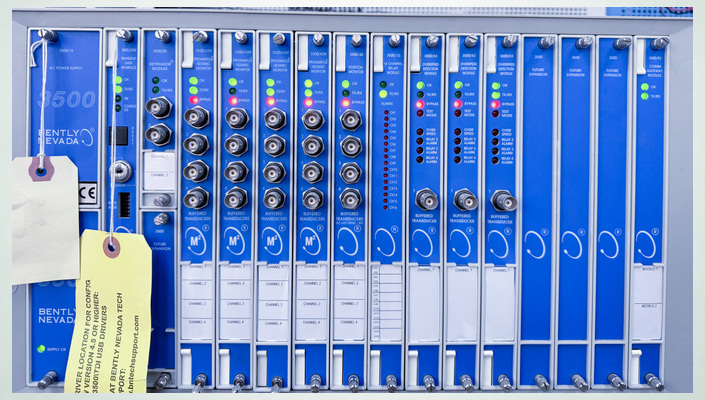
DEFINE THE UPGRADE BEFORE THE ORDER
01Installed rack
Complete module identities, revisions and existing configuration.
02Matching I/O
The front module and rear interface belong in the same scope.
03Required data
Define the information the project must demonstrate at acceptance.
01 / DEFINE THE SCOPE
A failed 3500/20 Rack Interface Module can turn an ordinary spare-parts enquiry into an upgrade discussion. The 3500/22M Transient Data Interface, or TDI, offers a path worth evaluating, but the purchase needs to address the installed rack and its software connections. Ordering the front module first and discovering the remaining work during a shutdown is an expensive way to define the project.
The key distinction is between restoring an established function and adding a new one. A plant that wants its existing connection working again has a different requirement from a reliability team that wants better access to waveform data. Both may discuss the same TDI hardware, yet the second project can involve a broader software and data-enabling scope.
02 / DATA AND PROTECTION
Bently Nevada describes the TDI as combining the RIM function with communications-processor data collection. Static data capture is standard; dynamic and high-resolution transient collection depends on the optional channel-enabling provision. The manufacturer also places the TDI outside the critical machinery-protection monitoring path during proper, normal system operation.
This separation helps explain why a communication problem and a protection problem should not be treated as the same fault. Losing access to data in host software does not, by itself, describe the state of every protection function. Equally, seeing normal machine readings does not prove that the data service required by the project is available. The investigation should establish which function has failed before deciding what hardware to buy.
For an upgrade, translate the desired benefit into an observable result. If the requirement is waveform access, a successful Ethernet connection alone is too narrow an acceptance target. If the requirement is restoration, unrelated new features need not become part of an urgent outage.
03 / COMPATIBILITY
The official datasheet warns that some existing 3500 M modules may be incompatible with the 3500/22. It does not provide a universal statement that every historical rack can accept the change without further work.
A family designation gives the reviewer a starting point, while the actual hardware and firmware history determines which question needs answering. A rack assembled in stages may contain modules purchased years apart. Assuming that the newest datasheet describes every installed unit can conceal exactly the difference that matters.
The most useful information is therefore specific: front and rear module identities, available version information, the existing configuration and the software that must connect afterward. Missing version information is a reason for a targeted technical enquiry, not a reason to buy a complete new rack automatically. Conversely, a supplier having a TDI available does not settle compatibility.
04 / MATCHING REAR I/O
One manufacturer warning is especially important: leaving the original RIM input/output, or I/O, module installed while fitting a new TDI will damage the TDI. The replacement must address the corresponding I/O; the front module cannot be treated in isolation.
The order also needs the intended interface and approval selections. A copper-network arrangement and a fibre connection lead to different supply decisions, and the existing project specification should explain which is required. Approval information should follow the full offered configuration rather than a general claim about the 3500 family.
These are purchasing decisions with installation consequences. They should be settled before equipment reaches the rack. The installation sequence, isolation arrangements and restoration of service belong in the applicable manufacturer instructions and the approved site procedure.
05 / MANUFACTURER-REPORTED CASE
An official Orbit report describes a compressor that experienced vibration trips after an overhaul. Engineers reviewed steady-state and transient data through System 1, investigating rubbing, stall or surge, and a developing impeller-to-journal fit issue. The report links their recommendations to the eventual repair scope, including impeller removal that had not initially been planned. It reports improved vibration behaviour after the mechanical work.
For a RIM-to-TDI project, the relevant lesson is to define the data the reliability team needs before pricing the upgrade. A requirement for trends alone differs from a requirement to examine waveforms and changes through a startup or shutdown.
This report does not identify a 3500/20 replacement or establish compatibility with a particular 3500/22M configuration. Those decisions still require the installed module details and the TDI datasheet, including matching I/O and the applicable data-enabling provision.
Use the case to sharpen the acceptance objective: demonstrate access to the diagnostic information purchased. Do not use the successful compressor repair as evidence that any TDI delivered to the site will provide that information automatically.
This is a Baker Hughes / Bently Nevada published case, not an EWOLO CONTROL project.
06 / COMPARE THE COMPLETE OFFER
An illustrative comparison makes the scope clearer. An urgent restoration may need replacement hardware and confirmation of the existing connection. A data-access upgrade may add enabling provisions and software work. A phased modernization may also need interfaces that suit a later project. None of these purposes is inherently better; they simply produce different cost and scheduling assumptions.
The following questions separate an apparently attractive component price from a complete offer. They also help a project manager avoid treating all unpriced work as if it were included.
| Quotation point | Why it changes the decision |
|---|---|
| Front module and matching I/O | A missing rear module changes both purchasing scope and installation readiness. |
| Required data functions | A network connection may not deliver every requested diagnostic function. |
| Compatibility-dependent items | Additional changes should be visible before the outage budget is approved. |
| Software and site work | Hardware supply does not automatically include configuration or commissioning. |
| Acceptance boundary | The price should relate to a stated delivery, not an assumed finished upgrade. |
For a RIM-to-TDI enquiry, send the installed module and I/O photographs together with the required replacement scope. This reduces the chance of receiving an incomplete quotation. EWOLO CONTROL supplies new, unused parts only. Availability, supporting documents, price, lead time and warranty remain specific to the full part number and written offer.
For the plant owner, the worthwhile question is whether the proposed supply can support the intended maintenance window after the technical dependencies are understood. An earlier delivery is useful only if the matching I/O and required engineering work are ready for the outage.
No. The original RIM I/O must not remain installed with the new TDI: the manufacturer warns that this combination will damage the TDI. Define the matching rear I/O as part of the replacement scope, and resolve installed-module compatibility before scheduling the upgrade.
Not automatically. The datasheet warns that some existing 3500 M modules may be incompatible, rather than requiring every installed module to be replaced. Review the actual module identities, available hardware and firmware versions, existing configuration and required software connection. Additional purchases should follow an identified compatibility or functional requirement.
Not necessarily. Static data capture is standard, while dynamic and high-resolution transient collection depends on the optional channel-enabling provision. Describe the data your reliability team needs before ordering. The acceptance scope should demonstrate those purchased functions; a successful network connection alone does not demonstrate the required waveform access.
They may cover different work and components. Compare the front module, matching I/O, interface selection, required data functions and any separately priced software or site work. The ordering information separates relevant hardware choices. Request an itemised scope before comparing totals, so an omitted component is not mistaken for a saving.
Ask them to demonstrate the agreed hardware and configuration, the required software connection and the specific data functions purchased. If the change affects other system relationships, include those within the approved test scope. A restoration project and a new diagnostic-data project can require different evidence, even when both use TDI hardware.
Send the complete installed and requested part numbers, front and rear label photographs, quantity, available hardware and firmware versions, and the intended replacement scope. Include the required data functions, delivery country and required-on-site date. Our supply policy is new, unused parts only. Availability, documents, price, lead time and warranty are confirmed for the exact item in the written quotation; these commercial details do not establish compatibility.
Send one clear parts list that ties the requested hardware to the installed rack and intended data functions.
Email confirmation → Requirement review → Written quotation
Hardware sourcing does not include automatic confirmation of rack compatibility, software licensing or commissioning. Agree these responsibilities with the relevant technical provider and site engineering team.
References reviewed 19 October 2026. Confirm the current revision and applicability to the installed and ordered variants.
No online payment is requested. Final price and terms are supplied in a written quotation.
Scan to Wechat :

Scan to WhatsApp :