
Can you reuse probes, wiring and cabinets in an Orbit 60 retrofit?
Often, selected parts can remain—but each item needs its own assessment. Verify the complete sensor chain, the exact rear I/O and terminal arrangement, cable condition and cabinet layout. Plan for documented exceptions, including unsupported 3000-series Proximitor sensors and replacement of 3500 thermocouple external termination blocks.
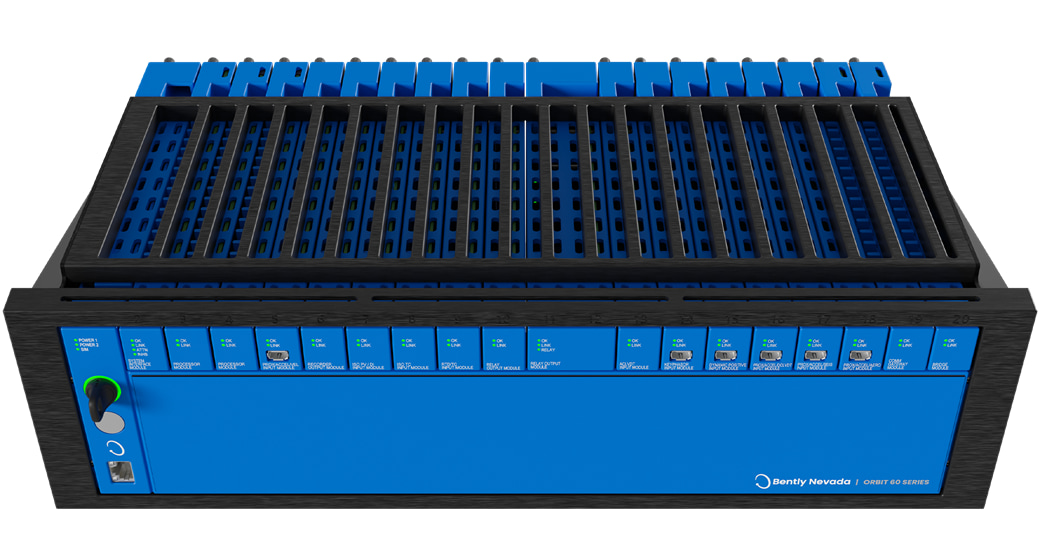
Decide what stays before removing the old rack
An Orbit 60 retrofit does not automatically require replacing every probe, cable and cabinet. Equally, a quotation that assumes everything outside the rack can remain is incomplete. Reuse depends on the exact sensor chain, electrical interfaces, physical condition and proposed layout. Each retained item becomes part of the new installation's design.
The financial attraction is clear: keeping suitable field equipment can reduce material, installation and access work. The cost appears later if an assumed interface proves incompatible or a cable no longer reaches its termination. Good reuse decisions are therefore made while the replacement is being designed, not after the old rack has been removed.
This article concerns a 3500-to-Orbit 60 retrofit. The manufacturer's retrofit white paper requires individual assessment and does not provide the detailed replacement design for 3300, Encore or competitor racks. [1]
Probes: assess the complete measurement chain
A proximity probe's label is only one part of a channel. The probe, extension cable and signal conditioner form a measurement system, which then connects to a monitoring input. Matching a familiar sensor name to a new input family without checking the rest of that chain can preserve the wrong combination.
Electrical characteristics and intended measurement both matter. A signal accepted by an input is not, by itself, proof that the complete application is correct. The selected configuration must represent the required measurement, with the appropriate scaling, reference and associated protection design. A retrofit should not quietly turn a known machine parameter into a superficially similar one.
Wiring: identify the exact external termination arrangement
The Orbit 60 System Overview datasheet, 137M5182 Rev. AB, lists adapters for specific 3500 external termination arrangements. It explains that many installations can retain their field terminations using the appropriate adapter, while the old external termination cables are not directly compatible on their own. [2]
That is more useful than a blanket rewiring assumption, but it still requires exact identification. A front monitor number does not fully describe its rear input/output option and terminal block. The applicable adapter comes from the actual combination, rather than whichever connector looks mechanically similar.
For supported external-termination arrangements
Identify the exact combination before selecting parts; this is a scope overview, not a wiring diagram.
Some configurations also distribute channels or control inputs differently. This can require more than a one-for-one adapter even when the field cable itself remains. The current system datasheet should govern the exact interface assessment; an older retrofit document that discusses adapters as future developments is not an up-to-date adapter catalogue.
Internal terminations need a separate check. The retrofit white paper states that the 3500 green plug-in terminal connectors must be replaced with the connectors supplied with Orbit 60. Reusing suitable field wiring does not mean retaining its original plug-in connector. [1]
Cabinets: check condition, cable reach and access
A cable can pass a present inspection yet still be an unattractive item to retain for a long operating horizon. Exposure, insulation condition, damaged shielding, undocumented joints and difficult future access influence the decision. Calendar age is relevant, but it is not a substitute for understanding the installation.
Mechanical fit has the same limitation. A new chassis fitting the opening says little about access to terminals, power equipment, ventilation or the route of the incoming cables. Moving the termination plane can consume service-loop length. Adding auxiliary equipment can make a previously accessible cabinet difficult to maintain.
The reasonable compromise is often selective reuse. Retain clearly suitable parts, replace items with a known incompatibility, and resolve uncertain field items before committing the final scope. This gives the project a defensible material saving without assuming that every old component deserves another full service period.
What may stay—and what can change the decision
| Existing item | Possible approach | Reason the answer may change |
|---|---|---|
| Compatible sensor chain | Retain after application assessment | Input requirements or field condition |
| Supported external termination arrangement | Use its specified adapter [2] | Exact input/output and terminal-block variant |
| 3500 thermocouple external block | Replace [2] | Different cold-junction compensation |
| Field cable and cabinet | Reuse where the new layout remains suitable | Condition, reach, access and added equipment |
Manufacturer field report · 3300 conversion · Q3 2022
Reusing the cabinet still required installation changes
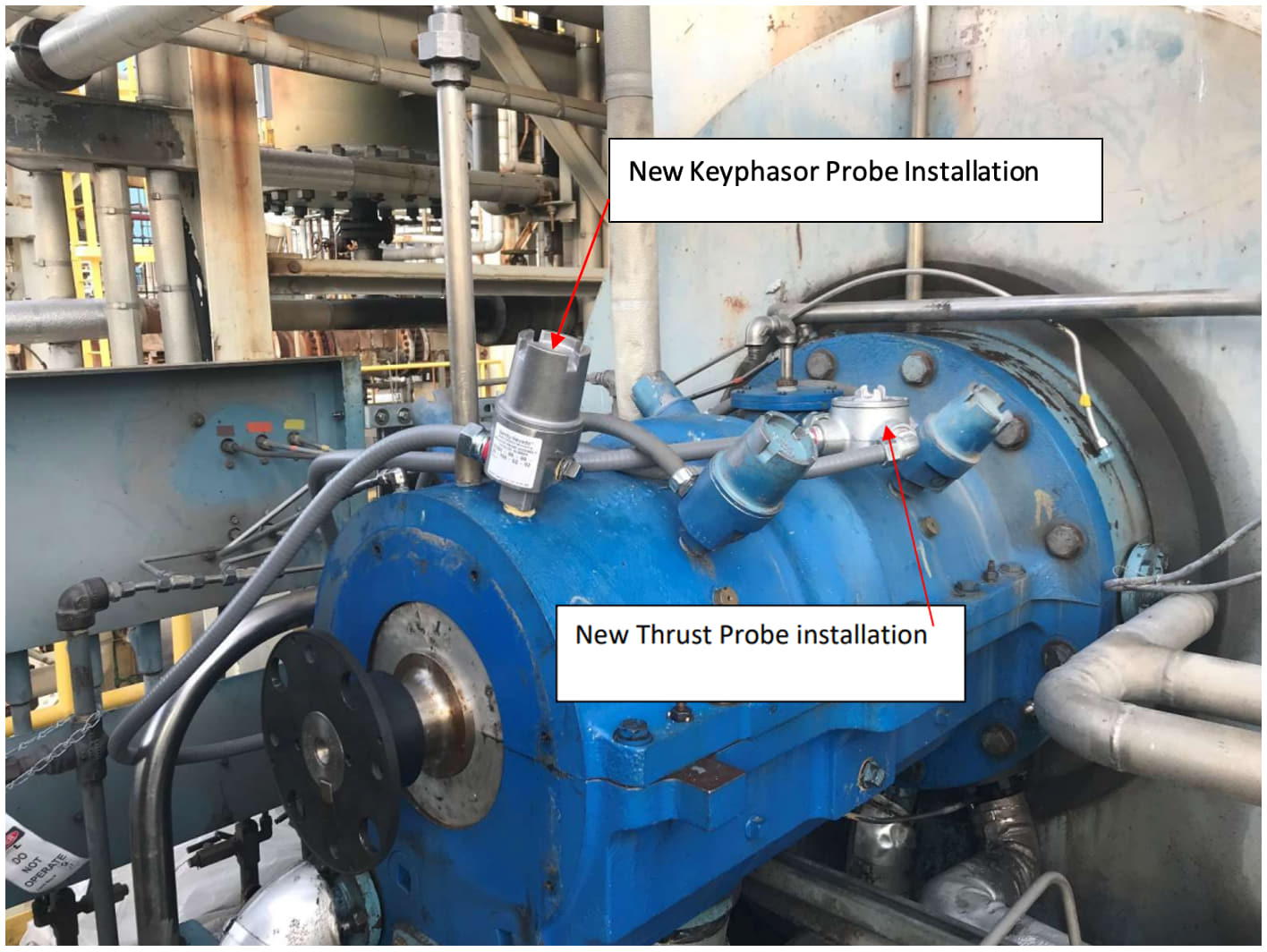
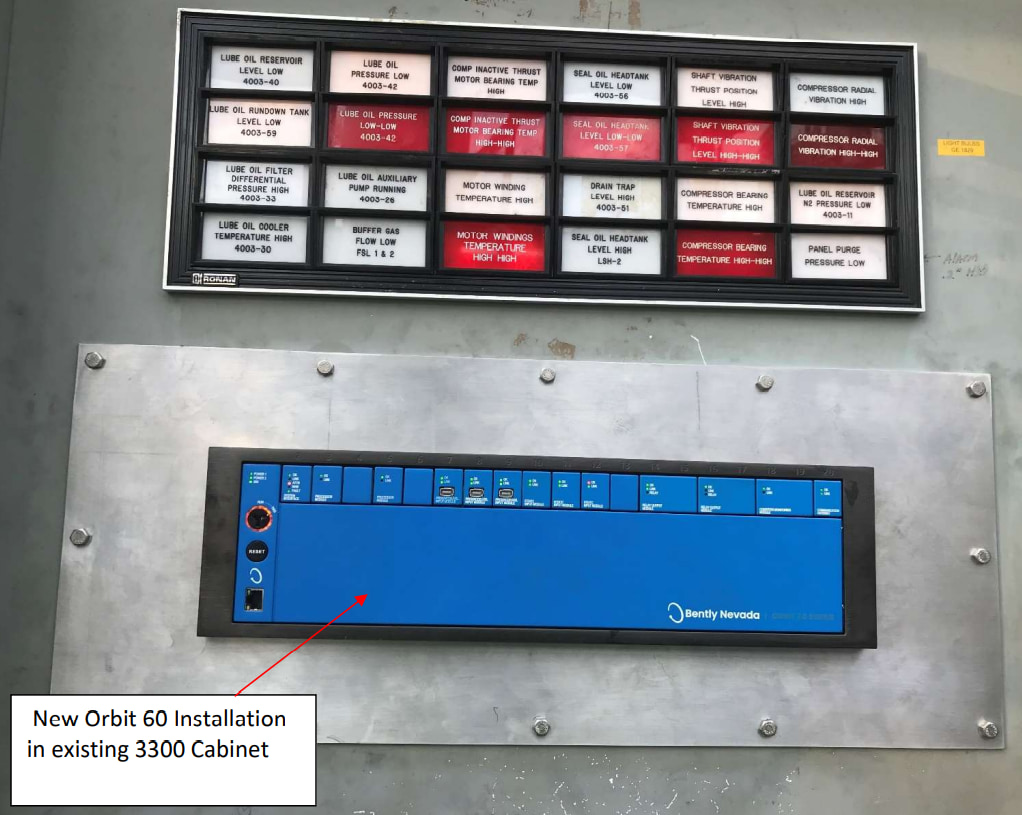
An official Q3 2022 Orbit report describes an October 2021 project replacing old 3300 monitors with Orbit 60 on two compressors. The existing cabinets and transducers were retained, but new blanking plates were required. Each machine also received another thrust probe, and one Keyphasor required relocation and a new bracket. [3]
The report records system checks before startup and says the installation had operated as expected for almost a year. [3]
The practical lesson is that reuse and modification can coexist in the same project. Retaining a cabinet does not eliminate mechanical work, and retaining the original transducers does not mean the final sensor arrangement remains unchanged. A useful quotation separates retained equipment from new plates, brackets, sensing points and commissioning work.
This report concerns a 3300 conversion, not a universal compatibility test for 3500 accessories. For the 3500-to-Orbit 60 scope of this article, evaluate the actual installation individually and apply the documented external-termination options and thermocouple exceptions. [1][2] Use the field report to ask better scope questions; use the applicable technical documents to decide which specific parts can remain.
Separate retained equipment from new supply
Procurement is easier when retained equipment and newly required material are separated in the bill of materials. Otherwise, a supplier can quote a complete new sensor set that the project does not need, or omit adapters assumed to be included elsewhere. The order should identify the intended configuration, not simply say “Orbit 60 upgrade kit”.
For an EWOLO CONTROL retrofit enquiry, provide the approved new-material list and identify any legacy parts needed during the transition. Include complete ordering codes, quantities, installation country and required dates. Availability, condition, supporting documents and delivery timing are confirmed for each quoted item, keeping retained equipment separate from new supply.
Retained equipment
List sensor chains, field cables, terminals and cabinet items approved to remain.
New material
List required modules, adapters, terminal blocks, mounting parts and new sensing points.
Transition spares
Identify legacy parts required while the replacement project is being prepared.
Quotation details
Provide complete ordering codes, quantities, installation country and required dates.
Questions before planning reuse
Can we keep our existing probes when replacing 3500 with Orbit 60?
Possibly, but the complete measurement chain must suit the proposed input and application. A probe name alone leaves out the extension cable and signal conditioner. There are specific exceptions, including unsupported 3000-series Proximitor sensors. [1] Assess each chain before ordering, and retain commissioning work even where the field equipment remains.
Can the existing external termination cables plug directly into Orbit 60?
No, they are not directly compatible on their own. The current system datasheet identifies adapters for specific 3500 external termination arrangements, allowing many field terminations to remain. [2] Selection depends on the exact rear input/output and terminal-block combination. Match that combination to the applicable adapter arrangement before adding parts to the order.
Why must our thermocouple terminal block change if the field wiring is still good?
Because the termination block contributes to the temperature measurement. The 3500 and Orbit 60 cold-junction-compensation components are not interchangeable, so the manufacturer's datasheet requires replacing the existing 3500 thermocouple external block. [2] Suitable field wiring may remain, but the replacement design must include the correct terminal arrangement rather than preserve the old block.
The new chassis fits our cabinet. Can we remove cabinet work from the budget?
Not on that basis alone. Physical fit does not establish cable reach, ventilation, power-equipment space or maintenance access. A changed termination position can also consume existing cable slack. Review the complete installed layout, including auxiliary equipment, before treating the enclosure as a fully reusable item with no associated work.
Is a photograph of the rack enough to prepare the retrofit materials list?
A photograph helps identify the installation but usually does not describe every interface. The material list also needs the front and rear module identities, terminal arrangements, sensor chains, required outputs and intended layout. Separate retained items from new supply so adapters or associated equipment are neither omitted nor ordered twice.
Can EWOLO CONTROL quote only the parts our approved retrofit design needs?
Send the approved new-material list rather than a broad request for an upgrade kit. EWOLO CONTROL can review the required items individually. Include complete ordering codes, quantities, installation country and required dates so the quotation can confirm availability, condition, supporting documents and delivery terms without assuming a universal retrofit package.
Quote the parts your approved design needs
Send the new-material list and identify any legacy spares needed during the transition.
Sources and technical references
Official sources checked on 29 October 2026. Confirm current revisions and applicability to the ordered variant. Historical field reports do not establish compatibility for a different installation.